
Your roof is showing warning signs right now, and most Pasadena homeowners will not notice them until real damage has already set in. A stain on your ceiling, a shingle curling at the edge, or a faint musty smell in your attic are not just minor inconveniences. They are your roof speaking. And when your roof speaks, you need to listen before a small problem becomes a structural nightmare that costs you thousands of dollars.
Whether your home sits in Bungalow Heaven, Hastings Ranch, or anywhere across the greater Pasadena area, the combination of Southern California’s intense UV exposure, Santa Ana wind events, and occasional heavy winter rain puts your roofing system under constant stress. This guide will walk you through every major warning sign that tells you your home needs roof repair in Pasadena, CA, and why acting fast is always the smarter move.
1. Water Stains on Ceilings or Walls
If you walk into a room and see a brownish, yellowish, or circular stain spreading across your ceiling, that is one of the clearest signs your roof has already been compromised. Water does not travel in a straight line. It flows along roof decking, rafters, and insulation before eventually finding a low point and dripping down into your living space. This means the visible stain is rarely directly below the actual source of the leak.
What makes ceiling stains particularly dangerous in Pasadena homes is that they can appear and disappear depending on rainfall patterns. A stain that seems dry after a sunny week has not resolved itself. The moisture has simply absorbed into the materials around it, and the next rainstorm will reactivate the problem. Over time, this cycle saturates your insulation, weakens your roof decking, and creates the perfect environment for mold and mildew to take hold.
What to do: Do not paint over the stain or ignore it. Call a roofing professional to trace the leak to its source, whether it originates from damaged flashing, worn underlayment, or cracked shingles.
2. Missing, Cracked, or Curling Shingles
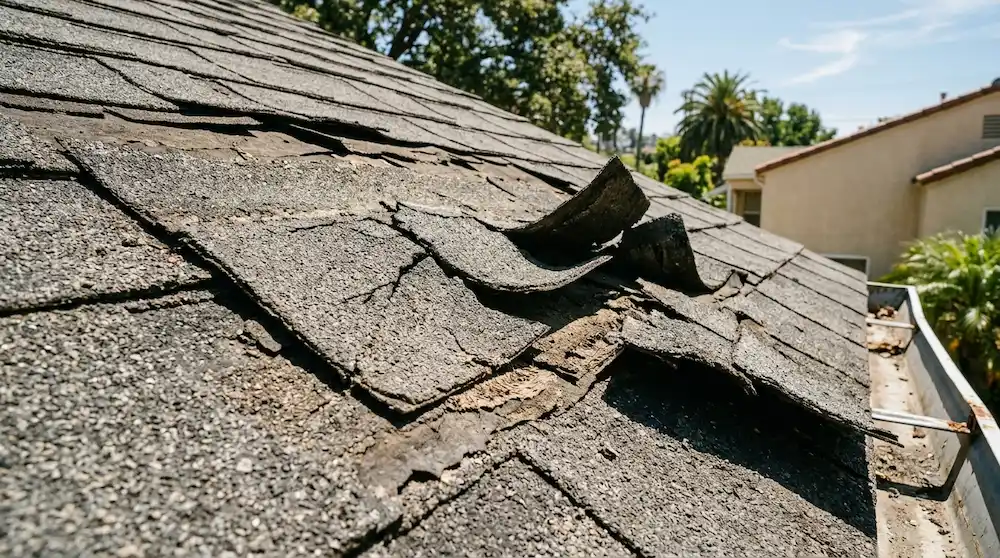
Asphalt shingles are the most common roofing material on Pasadena residential homes, and they are also the first to show visible signs of failure. When shingles begin to curl upward at the edges, a condition called cupping, or curl downward in the middle, known as clawing, it means they have reached the end of their effective service life. Cracked shingles have lost structural integrity. Missing shingles expose the underlayment and roof deck directly to rain, wind, and UV rays.
In Pasadena, Santa Ana winds are particularly aggressive at lifting and dislodging shingles that are already aged or improperly fastened. A single missing shingle following a wind event might seem like nothing. But that one gap gives water a direct entry point, and Pasadena’s winter rains are capable of forcing significant amounts of moisture into that opening within a matter of minutes.
If you can safely view your roofline from the ground and you notice uneven patches, bald spots, or missing sections, treat that as a call to action. Do not wait for the next storm to confirm the problem.
3. Granules Filling Your Gutters
Every time you clean your gutters, pay attention to what you find inside them. Asphalt shingles are coated with granules, small mineral particles that protect the shingle surface from UV radiation and add fire resistance. As shingles age, these granules detach and wash off into the gutter system during rain.
Finding a few granules occasionally is normal. Finding what looks like coarse, dark sand in large quantities is a serious red flag. Granule loss accelerates shingle degradation at a rapid rate because, without that protective coating, the asphalt base bakes under the California sun and becomes brittle, cracked, and prone to leaking.
If you notice bald patches on individual shingles or significant granule accumulation in your downspouts, your roof is communicating a need for professional evaluation. This is especially relevant for Pasadena homes with roofs that are ten years old or older.
4. Sagging Roof Sections
A sagging roof is not a cosmetic problem. It is a structural emergency. If any section of your roofline appears to dip, bow, or curve inward, the cause is almost always internal. Sagging can result from rotted roof decking, waterlogged insulation, damaged rafters, or even the accumulated weight of multiple roofing layers.
In Pasadena, properties with older construction, sagging sometimes develops slowly over the years and goes unnoticed until the problem is severe. You can often spot sagging from the street by looking for areas where the roofline appears uneven or where specific sections seem to pull away from the ridge. If you notice doors or windows inside your home suddenly sticking or not closing properly, that can also be a secondary sign that structural shifting related to roof stress is occurring.
Sagging is one of the only roofing conditions where waiting even a few extra weeks can lead to a partial or complete roof collapse. Contact a licensed roofing contractor in Pasadena immediately if you observe this sign.
Related: How Much Does a New Roof Cost in Pasadena, CA? (2026 Pricing Guide)
5. Damaged or Deteriorated Flashing
Flashing is the metal material installed around roof penetrations such as chimneys, skylights, vents, and valleys where two roof sections meet. It creates a watertight seal at every vulnerable joint in your roofing system. When flashing corrodes, pulls away, or cracks, water can enter directly at those junction points.
This is one of the most misunderstood and overlooked signs of roof damage because flashing failure is not always visible from the ground. Many Pasadena homeowners only discover failing flashing after water damage has already appeared on their interior walls near a chimney or skylight. Clay tile roofs, which are extremely common in the Pasadena area due to the region’s Spanish and Mediterranean architectural heritage, are particularly susceptible to flashing failures because the rigidity of the tile material creates stress at every junction point as temperatures shift throughout the year.
A trained roofing professional will inspect flashing as part of any comprehensive roof inspection, which is why regular maintenance checks matter as much as reactive repairs.
6. Light Entering Through the Roof in the Attic
This is a diagnostic check every Pasadena homeowner can do without climbing on their roof. On a sunny afternoon, go into your attic and turn off any lights. Give your eyes a moment to adjust. If you see beams of light coming through the roof boards or decking, you have gaps, cracks, or holes that are allowing water to enter during rainfall.
If daylight can get through, so can water, insects, and outside air. An attic that feels excessively hot compared to what it should based on your insulation is another clue that your roofing system is failing to regulate temperature properly. Poor attic ventilation tied to roofing damage is a common issue in Pasadena homes, where summer temperatures in the San Gabriel Valley can push attic heat to well over 150 degrees Fahrenheit, accelerating shingle deterioration from the inside out.
7. Mold, Mildew, or Moss Growth on the Roof Surface
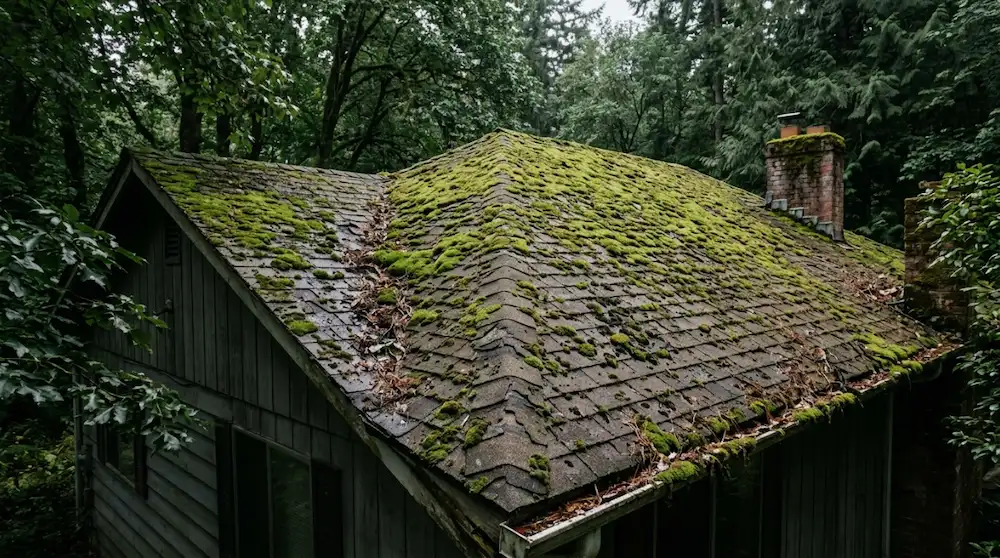
Pasadena’s microclimate, particularly in neighborhoods near the San Gabriel Mountains like Hastings Ranch and Linda Vista, creates conditions where moisture lingers long enough for biological growth to take hold on roofing materials. Moss, algae, and mildew are not just visually unappealing. They actively hold moisture against the roof surface, which speeds up shingle degradation and leads to premature leaking.
Algae tends to create dark, streaky stains that run down the slope of the roof. Moss forms thick, spongy patches that lift the edges of shingles and allow water to wick beneath them. Once it has established a presence on your roof, it spreads aggressively and causes disproportionate damage relative to how minor it looks from the street.
If you notice green or black growth covering portions of your roof, a professional roof cleaning combined with an inspection is necessary to assess how much underlying damage has occurred.
8. Spike in Your Energy Bills Without Explanation
Your roof plays a direct role in your home’s thermal performance. When roofing materials are damaged, gaps in the envelope allow conditioned air to escape and outdoor heat to enter. For Pasadena homeowners, where summer temperatures in the San Gabriel Valley regularly exceed 95 degrees Fahrenheit, a compromised roof can cause your air conditioning system to work significantly harder than it should.
If you notice a sudden or sustained increase in your electricity bill during warm months and cannot attribute it to changed behavior or increased usage, your roof may be the culprit. Damaged or missing insulation in the attic, often caused by moisture intrusion from roof leaks, is a primary driver of this energy loss. A proper roof inspection can identify whether roofing damage is contributing to your home’s energy inefficiency.
9. Visible Damage After a Storm or Wind Event
Pasadena sits in a geographic corridor where Santa Ana wind conditions can create damaging gusts that exceed 50 miles per hour during peak events. Following any significant wind event or rainstorm, a visual inspection of your roof from ground level is a responsible first step. Look for displaced tiles, torn shingles, debris impacted into the roofing surface, or any sections where roofing material appears to have shifted.
Beyond visible surface damage, post-storm inspections should also look for damage to gutters and downspouts that have been pulled away from the fascia, bent or cracked ridge caps, and any debris accumulation in valleys that could redirect water flow in harmful ways. If a tree branch has made contact with your roof, even a glancing blow, there may be structural damage beneath the surface that only a professional inspection can identify.
Do not assume that because your roof looks mostly intact after a storm that it is undamaged. Some of the most costly roofing failures in Pasadena homes originate from storm damage that was dismissed as minor.
While roofing issues vary by climate and construction style, homeowners often research Roof repair services in Houston to compare how different regions handle storm-related damage, leak prevention, and long-term roof maintenance.
10. Your Roof Is Approaching or Past 20 Years Old
Age is not a sign of damage, but it is the most reliable predictor of when damage is coming. In Southern California’s climate, standard three-tab asphalt shingles have an average lifespan of 15 to 20 years. Architectural shingles can last 25 to 30 years under ideal conditions. Clay and concrete tile roofs, commonly found on historic and Spanish-style homes in Pasadena, can last significantly longer but still require the mortar, underlayment, and flashing around them to be serviced at regular intervals.
If your home’s roof has not had a professional inspection in the last three to five years and the installation is approaching the two-decade mark, the likelihood of needing at least partial repairs is very high. An older roof that appears visually intact may still have deteriorated underlayment, failing sealants, or weakened decking that a surface inspection from the street will not reveal.
The most cost-effective approach for any Pasadena homeowner with a roof nearing the end of its expected lifespan is to schedule a professional inspection now, before a weather event turns a manageable repair into an urgent emergency.
Take Action Before the Next Storm Hits
Every warning sign on this list has one thing in common. Each one gets significantly worse with time. A missing shingle becomes water-damaged decking. A small flashing gap becomes interior mold. A slow leak becomes structural rot. The pattern is consistent regardless of whether you are in Madison Heights, Playhouse Village, or Garfield Heights.
If you have spotted any of the signs described in this post, the next step is straightforward. Contact a trusted roof repair contractor in Pasadena, CA, for a professional inspection. Getting an expert evaluation now is the difference between a repair that costs you a few hundred dollars and a replacement that costs you tens of thousands.
Your roof protects everything beneath it. Treat the first warning sign seriously, and you protect not just your roof but every person and every possession inside your home.
Frequently Asked Questions
How do I know if my roof needs immediate repair?
Common warning signs include water stains, missing shingles, sagging roof sections, mold growth, and visible storm damage.
Can a small roof leak become a serious problem?
Yes. Even minor leaks can lead to mold growth, damaged insulation, rotted decking, and costly structural repairs if ignored.
How long does a roof repair usually take?
Most residential roof repairs in Pasadena can be completed within one day, depending on the extent of the damage.
Should I repair or replace my roof?
If the damage is isolated, repairs may be enough. Older roofs with widespread issues may require replacement after inspection.
Are missing shingles an emergency?
Yes. Missing shingles expose your roof deck to moisture and can quickly lead to leaks during rain or wind events.
How often should a roof be inspected in Pasadena?
Most roofing professionals recommend a roof inspection every 2–3 years and after major storms or wind events.
Need professional roof repair in Pasadena, CA? Call us today at (626) 828-0782 for a fast inspection and honest roofing recommendations before minor damage turns into a major repair.


